In HORECA chain management, purchasing swings between two extremes that are equally damaging: running out of product mid-service or accumulating merchandise that ends up expiring in the cold room. Both situations erode margin, but in different ways. Stock-outs force emergency purchases at premium prices and lost customer orders. Overstock generates waste, ties up capital and occupies storage space that costs money. The solution is not to buy more or buy less, but to buy exactly what is needed. And that is only possible when demand forecasting directly feeds the purchasing process.
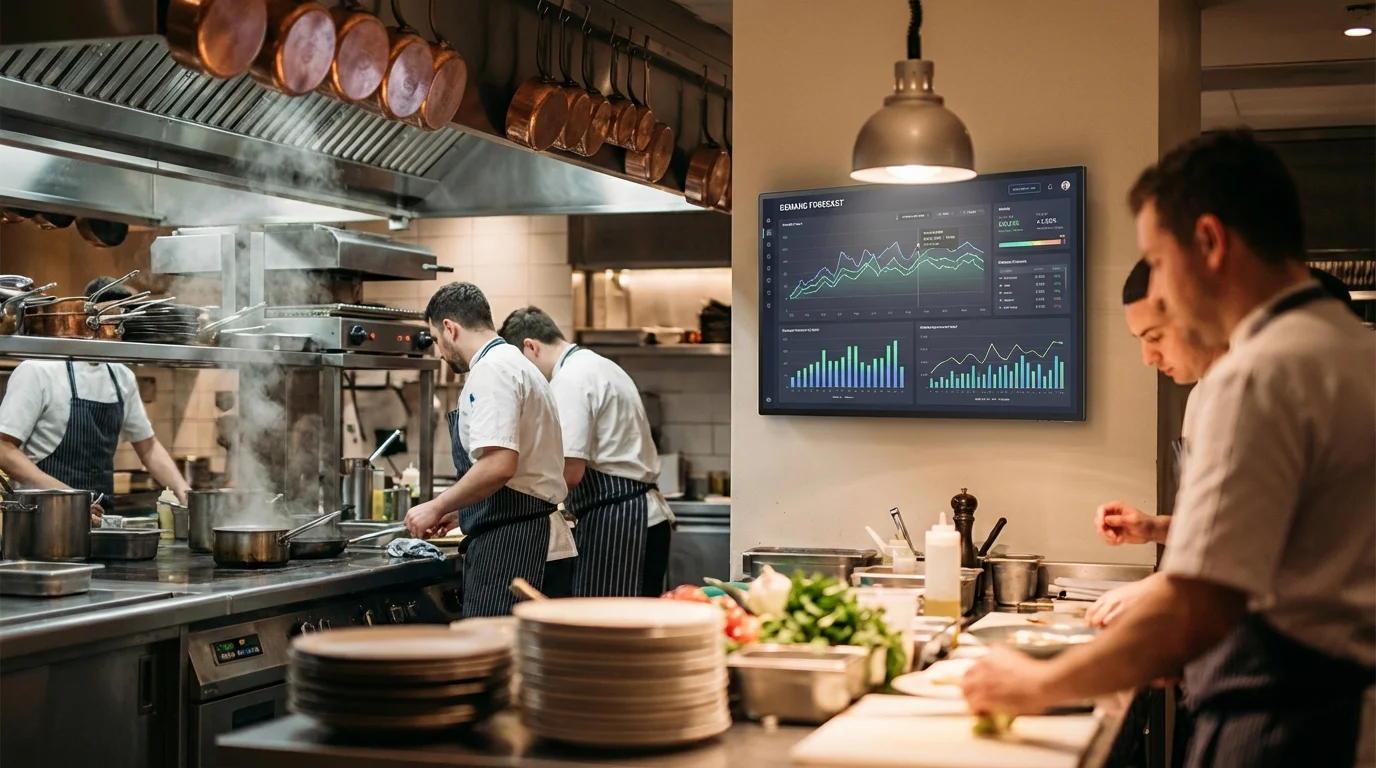
The two extremes that destroy margins
When a restaurant runs out of a key ingredient mid-service, the consequences go far beyond the dish that cannot be served. The manager has to improvise: call the supplier for an urgent shipment that will arrive with a surcharge, send someone to the nearest market paying retail prices, or simply remove dishes from the menu and lose sales. The cost of a single stock-out at a high-volume location can exceed 200-300 euros when you add the surcharge, staff time and lost sales.
At the other extreme, overstock seems less urgent but is equally corrosive. Product expiring in the cold room, waste accumulating week after week, capital tied up in ingredients that do not move, and a warehouse that always seems too small even though it never fills with what is actually needed. In chains with 15 or 20 locations, overstock waste can represent between 3% and 8% of total food purchasing.
Why manual orders always fail
In most chains, the purchasing process still depends on each location manager's judgment. The manager opens the cold room, looks at what is left, vaguely remembers what was sold last week and places an order based on intuition. This method, which the industry calls ordering by feel, has several structural flaws that worsen with scale.
Overcompensation after a stock-out
After suffering a stock-out, the manager's natural behavior is to over-order in the next cycle. If last Friday they ran out of sea bass, next Friday they will order double. But last Friday there was a sporting event that spiked demand, and this Friday will be a normal day. The result: overstock of sea bass that ends up as waste.
Invisible seasonal patterns
Restaurant chain demand follows complex patterns that no manager can mentally retain. Mondays in January are nothing like Mondays in June. Long-weekend weeks behave differently from normal weeks. Without processed historical data, these patterns simply are not captured.
From forecast to order: the pipeline you need
The correct process for generating an optimal purchase order follows a logical chain: Demand forecast by dish (how many servings of each dish will be sold tomorrow at each location) --> Recipe explosion to ingredients (what quantity of each ingredient is needed) --> Current stock deduction (what is already in the cold room and warehouse) --> Purchase order (the exact difference between what is needed and what is available).
How does Controliza connects Forecast with Purchasing?
Controliza's Forecast module generates a demand forecast by dish, by day and by location. It does not predict total sales or aggregate revenue: it predicts how many servings of each menu item will be sold at each center.
Once the forecast is generated, the Purchasing module takes over. It collects the forecasted demand by dish, cross-references it with updated recipe costings for each recipe to explode the needed ingredients, checks each location's current stock and automatically generates purchase orders for the next 2 to 3 days. The entire process happens without manual intervention.
Managing variability: beyond simple historical data
A forecasting system that only looks at last week’s sales to estimate next week’s adds no real value. Demand in foodservice is influenced by multiple interacting factors, and Controliza’s Forecasting engine takes all of them into account.
Day-of-week patterns
Each site has its own weekly profile. Tuesdays may be the slowest day, while Thursdays are the busiest because there’s a nearby street market. The system learns these patterns site by site instead of applying a generic average.
Seasonality and calendar effects
School holidays, long weekends, local public holidays, the beginning and end of the month, high and low season. The system identifies how each calendar period affects demand for every dish at every location.
Weather impact and events
A terrace that generates 30% more revenue on sunny days needs a forecast that includes the weather outlook. A venue next to a stadium needs to adjust demand on match days. These external factors make the difference between a useful forecast and one that falls short.
Historical demand by item
Not all dishes behave the same way. Salads increase in summer and decline in winter. Stews do the opposite. Desserts tend to remain more stable. The system models each item independently because forecasting at an aggregated level is not enough to generate orders for specific ingredients.
The virtuous cycle: from forecasting to savings
When forecasting automatically drives purchasing, it sets off a virtuous cycle that improves margins from multiple angles at the same time:
Better forecasting reduces stockouts. Fewer stockouts mean fewer emergency purchases. Fewer emergency purchases make it possible to consolidate orders with your regular suppliers and negotiate better volume pricing. Better purchase prices reduce food cost. Lower food cost frees up margin that you can reinvest in product, staff, or growth.
At the same time, buying only what you need eliminates overstock, reduces waste from expired products, and frees up working capital. A venue that no longer has €2,000 tied up in unnecessary stock can use that money for operations that generate a return.
Why forecasts fail without real operational context
Even chains that already “forecast” demand often keep missing purchases because the forecast is built at the wrong level. A weekly sales estimate by location is not enough to decide what to buy tomorrow. Purchasing needs a forecast by dish, by day, by service and by location, connected to the actual recipe costing of each menu item. Otherwise, the order may look correct in total value but fail in the ingredients that matter: too much garnish, not enough protein, excess fresh produce with short shelf life, or frozen stock that never gets rotated. This is where margin leaks silently: not only through waste, but through distorted food cost, rushed substitutions and poor traceability when products are moved or replaced at the last minute.
The problem gets worse when demand is affected by factors that managers cannot model manually. Weather shifts terrace traffic. Local events change the mix between dine-in and delivery. Hotel occupancy alters breakfast and lunch volumes. Holidays, promotions and menu changes break historical patterns. A chain may think it is buying based on experience, but experience alone does not detect these variables consistently across all locations. That is why static par levels and spreadsheet-based orders generate recurring errors: they ignore external signals, channel mix and outliers. The result is predictable—overproduction on quiet days, stock-outs on peak days, and delivery notes full of urgent corrections that create more admin work than control.
Controliza Forecasting solves this by turning fragmented operational data into a usable purchasing signal. The platform anticipates demand by dish, day and location, incorporating weather, holidays, events and occupancy patterns, then translates that forecast into the ingredient quantities you actually need for mise en place, thawing and supplier orders. Because the forecast is linked to recipes, purchasing stops being an isolated task and becomes part of a closed operational loop: what you expect to sell, what you need to produce, and what you need to buy. In practice, this reduces waste by 20-30%, cuts stock-outs by up to 40% and keeps production deviation versus real demand below 10%.
The practical implication is simple: better forecasting is not only a planning improvement, it is a purchasing control system. You buy closer to real consumption, protect food cost, reduce avoidable waste and improve traceability from forecast to delivery notes to stock movement. Instead of reacting to shortages and excess after they happen, you prevent them before the order is placed. That is how chains stop choosing between stock-out and overstock and start operating with precision.
What impact does it have on margin?
Data measured in active Controliza clients.
In a 20-location chain with a monthly food spend of 300,000 euros, a 3% saving in food cost represents 9,000 euros per month. 108,000 euros per year.
If you want to go deeper, we recommend reading MICE and Conventions: Forecasting F&B for Extreme Demand Peaks and New menu, new forecast: how to launch dishes without breaking your prediction.

