AI-powered centralized purchasing
Automated orders based on what you actually sell
Automate orders, centralize suppliers and control prices across all your locations.












Who controls what each location buys?
In multi-location groups, each site purchases its own way: different suppliers, uncontrolled prices, emergency orders and zero visibility from headquarters. The result is food cost spiraling with no one knowing exactly where.
Stock never adds up
Counts are manual, each location has its own way of counting, and book stock doesn't match actual stock. Differences are discovered too late.
Every manager orders their own way
Without an approved catalog, each location buys different products from different suppliers at different prices. No standard, no control over what enters each location.
No price or contract control
Suppliers raise prices without notice and off-contract purchases pile up. You don't detect deviations until the monthly close, when it's too late to act.
How Purchasing Works
A centralized purchasing platform that connects prediction, stock, recipe costing and suppliers to generate optimized automated orders at each location.
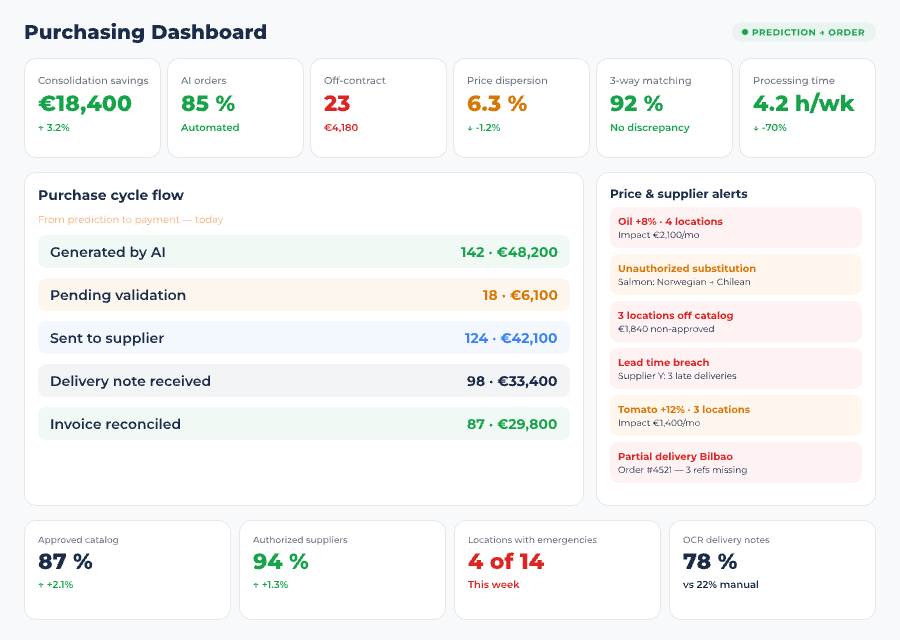
AI-Suggested Orders
The system crosses the demand prediction with each location's current stock and your menu's recipe costing to automatically generate suggested orders. The manager reviews, adjusts if needed and sends with one click. No spreadsheets, no phone calls, no errors.
- Prediction + stock + recipe costing -- the order is calculated with real data, not the on-duty manager's gut feeling. Includes finished products and raw ingredients
- Smart multi-supplier -- if a supplier is out of stock or their price has deviated, the system suggests an alternative from the approved catalog
- Lead time per supplier -- orders are generated with sufficient advance based on the actual delivery time of each supplier and location
Price and Supplier Control
Every delivery note is automatically matched against the order and the current contract. If the price has increased, if the quantity doesn't match or if the product wasn't in the order, the system detects it instantly. No waiting until the monthly close to discover deviations.
- Delivery note-order-contract matching -- detects price, quantity and product deviations at the time of reception, not weeks later
- Silent price increase alerts -- if a supplier raises prices by 3% without notice, you know today. Not when you close the month's P&L
- Price history -- price evolution by item, supplier and period. Data to negotiate with evidence, not intuition
Centralized Multi-Supplier Catalog
A single approved product catalog for the entire group, with negotiated prices, validated suppliers and equivalences per location. The manager doesn't choose the supplier: they choose the product. The system assigns the optimal supplier based on price, availability and area.
- Approved catalog -- products, brands, formats and prices validated by headquarters. Each location only sees what they can order
- Automatic equivalences -- if a location needs a product that has a different format with another supplier, the system handles it without manual intervention
- Volume consolidation -- aggregates orders from all locations to negotiate better terms. Higher volume, better price
Elimination of Off-Contract Purchases
Every order goes through the group's rules: approved catalog, authorized supplier, price within contract. If a manager tries to order outside the norm, the system blocks it or escalates for approval. No silent exceptions eroding margin.
- Group purchasing rules -- define what each location can order, from whom and at what maximum price. The system enforces it without human intervention
- Approval workflow -- orders exceeding limits or including non-approved products require headquarters approval before being sent
- Full visibility -- from headquarters you see in real time what has been ordered, received and deviated. By location, by supplier, by period
Measurable Impact on Purchasing and Food Cost
Discover how to centralize purchasing across your entire group
Request a Free DemoPurchasing Within the Cycle
Purchasing doesn't work in isolation. It is fed by prediction and feeds production in a closed loop.
Forecast generates the forecast
The ML engine calculates how much you will sell tomorrow at each location, by dish and time slot. That forecast is the basis for calculating what you need to purchase.
Purchasing generates automated orders
The module crosses prediction with current stock, recipe costing and supplier lead times to generate suggested orders. The manager reviews and sends with one click.
Kitchen produces with real data
The production plan is generated with the same forecast and the received stock. Defrosting, mise en place and picking lists calculated, not improvised.
Purchasing Adapted to Each Sector
The same centralized purchasing platform, adapted to the operational context of your sector.
Restaurants
Automated orders based on menu, recipe costing and prediction by location. Approved catalog for chains and franchises.
Hotels
F&B purchasing adjusted to PMS occupancy and events. Multi-consumption-point management with centralized stock.
Food Service
Purchasing adjusted to cyclic menus and actual diners. Batch traceability and allergen control for compliance.
Frequently asked questions about Purchasing
What is centralized purchasing in hospitality?
A model where head office defines the catalog, the suppliers and the approved prices, and each location orders within those rules. In a HORECA group it lowers food cost because it eliminates off-contract purchasing, consolidates volume and gives visibility into what each site buys.
Does Controliza replace my ERP or my central purchasing office?
No: it complements them. Your ERP consolidates and books the accounts, your purchasing office negotiates, and Controliza enforces the purchasing policy at each location —approved orders, validated goods receipt—, which is where the negotiated saving becomes a real saving.
How does it control prices and supplier discrepancies?
Every delivery note is automatically matched against the order and the current contract. If the supplier raises the price, changes the quantity or delivers a product that wasn't ordered, it's caught at goods receipt —not at the month-end close—, while you can still dispute it.
Does it work with multiple locations and multiple suppliers?
Yes, that's its main use case: a single multi-supplier catalog for the whole group, with per-site equivalences and volume consolidation. Head office sees in real time what has been ordered, received and flagged as a discrepancy at each location. Related guide: how to choose suppliers in hospitality.
How does traditional purchasing management differ from AI-driven centralized purchasing?
Traditional purchasing management works location by location: each manager orders their own way, with no shared catalog and no price control. AI-driven centralized purchasing turns that purchasing management into a single process for the whole group —an approved catalog, suggested orders based on what you sell, and discrepancies caught at goods receipt—, so the negotiated saving actually reaches every location.

