AI-powered demand prediction
Know what you will sell before you prepare it
Prediction by dish, shift and location with adaptive ML. Your mise en place is no longer a guess.












Do you know how much each location will sell tomorrow?
In multi-location chains, demand variability shifts daily due to weather, holidays, events and seasonality. Without a reliable forecasting engine, each location improvises how much to produce and order — and waste multiplies.
You don't know how much you'll sell
You over-purchase, mise en place is excessive, you throw away food. Product rotation is poor and waste grows without knowing exactly where.
New staff improvises
Every time a new manager or chef starts, quantities depend on gut feeling. Without data, operational onboarding takes months.
Invisible deviations across locations
Each location operates with different metrics. You can't compare food cost, waste or accuracy across locations until the monthly close.
How Forecast Works
An adaptive ML engine that learns from your real data -- sales, seasonality, events, weather -- and generates an actionable prediction for each location.
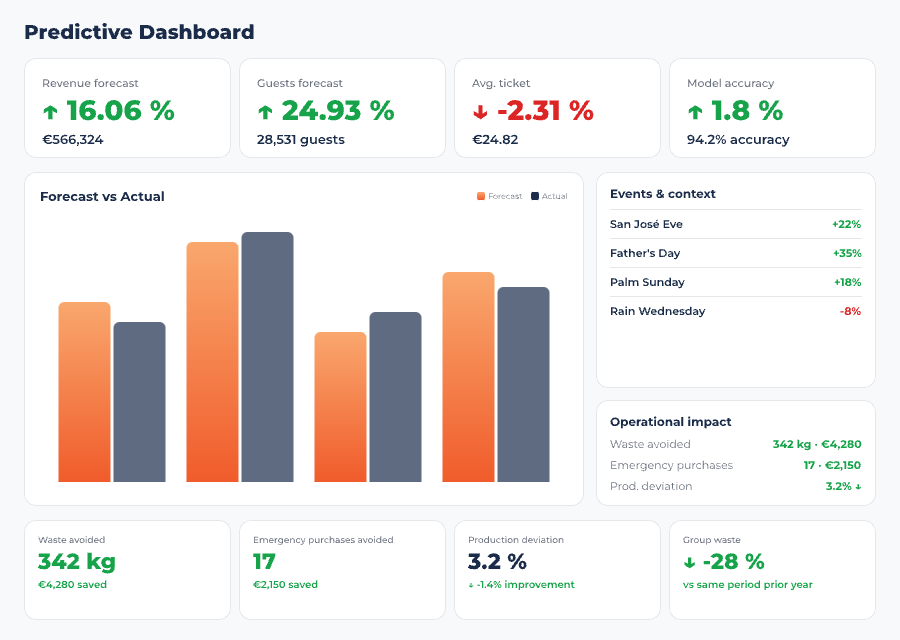
Prediction by Dish, Channel and Location
Every morning, each location has its prediction: how many servings of each dish you will sell, broken down by time slot and channel (dine-in, delivery, takeaway). The model distinguishes channels because each one has a different menu mix.
- True granularity -- prediction by individual dish, not by category. You know how many classic burgers and how many chicken burgers you need for Tuesday lunch
- Multi-channel -- dine-in, delivery and takeaway generate different demand. The model learns and predicts each one separately
- Continuous retraining -- the model recalibrates with actual sales data every day. More data, more accuracy
Automatic Outlier Detection
Holidays, promotional campaigns, the Sunday match, rain: the model automatically detects atypical events and isolates their impact without contaminating your sales history. No need to manually configure calendars.
- Holidays and long weekends -- the model knows the calendar and adjusts the prediction for days with patterns different from a regular day
- Weather -- rainy days, heat waves or snow: demand changes and the model anticipates it
- Local events -- football match, concert, fairs: if it affects traffic at your location, the model detects it in the historical data and applies it
Benchmark Across Locations
Compare prediction accuracy, actual food cost and dish-by-dish deviations across all locations in the group from a single dashboard. Detect which locations need intervention before the impact hits the P&L.
- KPI comparison -- food cost, waste, average ticket and gross margin by location and period
- Deviations by dish -- identify which dishes generate the most waste at which locations. Data to act on, not to review at month-end
- Automatic alerts -- if a location deviates from the acceptable range on any KPI, you know today, not at the end of the month
New Menu and New Location Onboarding
A new dish without historical data starts with data from similar dishes in the group and adjusts in days. A new location inherits the group's configuration, menu and prediction from day one. No waiting months for useful data.
- Smart cold start -- new dishes start with the consumption profile of similar dishes in the group. In 5-7 days the model already has its own data
- New location = new node -- configuration, menu, suppliers and recipe costing are inherited from the group automatically. No reinventing processes
- New staff without a learning curve -- the manager doesn't need prior experience: the system tells them what to prepare, how much to order and what to defrost
Measurable Impact on Food Cost and Waste
Discover how prediction applies to your operations
Request a Free DemoPrediction Within the Cycle
Prediction is not a standalone module. It feeds purchasing, production and cost control in a closed loop.
Prediction generates the forecast
The model receives data from the POS (actual sales), calendar, weather and occupancy (PMS for hotels). Every night it recalculates the prediction by dish and location for the next day.
Purchasing calculates orders
The prediction feeds the purchasing module: it crosses the forecast with current stock and recipe costing to automatically generate suggested orders. The manager reviews and sends with one click.
Real data feeds back
Actual daily sales are compared with the prediction. Deviations adjust the model automatically. More data, more accuracy. Closed loop.
Prediction Adapted to Each Sector
The same prediction engine, adapted to the operational context of your sector.
Restaurants
Prediction by dish and channel for chains and franchises. Data-driven mise en place, not intuition.
Hotels
F&B prediction based on PMS occupancy and events. Each consumption point with independent prediction.
Food Service
Prediction of actual diners on cyclic menus. Adjustment for absenteeism and seasonality.
Frequently asked questions about Forecasting
What is demand forecasting in hospitality?
Estimating how much you'll sell —by dish, time slot and location— before it happens, with a machine learning model that learns from your history, public holidays, weather and campaigns. It's the foundation for buying and producing exactly what you need.
Does it work without sales history?
Yes: it starts with sector data and data from similar locations in your group, and it retrains on your real sales within the first few weeks. Accuracy climbs on its own as it accumulates data.
Does Controliza replace my POS or ERP?
No: it complements them. It reads sales from your POS and anticipates demand; your ERP handles the accounting. Controliza is the layer that turns that data into orders and production before the sale happens.
What does it factor in besides history?
Public holidays, weather, campaigns, seasonality and outliers that the human eye can't cross-reference. That's why it anticipates peaks and dips that a moving average in Excel misses. More: artificial intelligence in hospitality.

