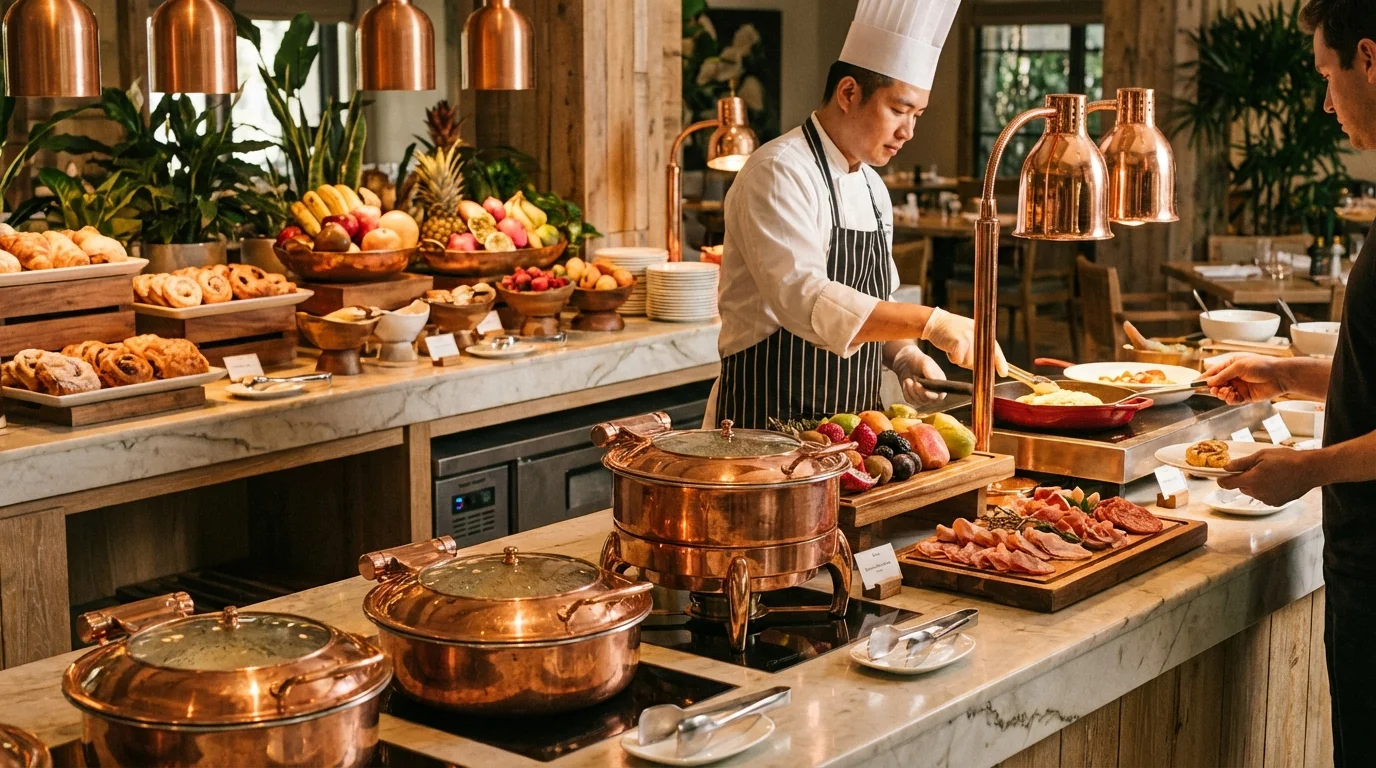
It is 10:30 in the morning at a 450-room all-inclusive resort. The breakfast buffet has been open for three hours. On the hot line, the trays of scrambled eggs and bacon are half empty. In the fruit area, the cut melons have been untouched for 45 minutes. The line cook replenishes what seems right. At closing, the team removes entire trays that go straight to the bin. Nobody weighs how much is thrown away. Nobody knows how much the food served cost versus what was actually consumed. The cost per diner for breakfast is a number that appears in a monthly spreadsheet two months late, calculated by dividing total purchases by occupancy. A number that says nothing operationally.
The most expensive and least measured hotel operation
The buffet is, by far, the most costly F&B operation in any hotel offering half board or all-inclusive. Unlike a la carte service, where each dish is prepared on demand and portion control is possible, the buffet requires producing large quantities of food before knowing how many people will consume it and what they will choose. It is, by nature, a planned overproduction operation.
The problem is not that there is some surplus: that is inherent to the format. The problem is that the vast majority of hotels do not measure what actually happens at the buffet. They do not know how many kilos of each dish are served, how much is replenished during service, how much is removed at the end, or how much ends up in the bin. Without that data, optimization is impossible.
What not measuring the buffet means
When a hotel does not measure actual buffet consumption, it works with averages and estimates. The cost per diner is calculated monthly by dividing purchases by covers. But that number does not distinguish between a Tuesday at 60% occupancy and a Saturday at 95%. It does not differentiate between high and low season. It does not reflect that the smoked salmon served on Sunday cost three times more than the cold cuts on Monday.
You don't know which dishes are profitable
Without consumption data per item, you cannot tell if the cut fruit platter that seems cheap is generating more waste than the premium cured meat platter that seems expensive. A dish with low ingredient cost but high waste can be more expensive than a premium one that is fully consumed. Without measurement, buffet menu decisions are made blind.
You don't know how much you actually waste
Visual waste estimation at the buffet underestimates the problem by 40-60%. Kitchen teams tend to minimize figures unconsciously: "we didn't throw away much today" is a common phrase that is never verified against any data. Without actual weighing, there is no baseline. And without a baseline, improvement is impossible. As with overproduction in the kitchen, the first step to reducing waste is to quantify it precisely.
You cannot compare across hotels
If you manage a hotel chain with buffets across several properties, the lack of data prevents you from establishing internal benchmarks. You do not know if the Mallorca hotel wastes more than the one in Tenerife, or why. You cannot replicate best practices from one hotel to the rest. Each chef does what they think is best, and the food cost varies across hotels in the same group without anyone knowing exactly why.
Data measured in active Controliza clients.
Why chef intuition does not scale
This is not a competence issue. Experienced buffet chefs have a refined intuition. But that intuition is non-transferable. When the head chef is on holiday, when there is staff turnover, when you open a second or third buffet hotel, that experience does not travel. The system does.
Moreover, intuition does not detect slow trends. If consumption of a dish drops 5% every week for two months, no chef notices until the tray starts coming back untouched. A system with historical data detects it in the second week and suggests adjusting production before waste accumulates.
How does technology opens the black box?
Computer vision on the buffet line
Cameras with computer vision installed above buffet trays identify each dish and monitor fill levels in real time. No human intervention is needed. The system knows that the smoked salmon tray is at 20% capacity, that the Mediterranean salad has had no movement for 15 minutes, and that scrambled eggs run out every 25 minutes.
Continuous automatic weighing
Scales integrated into the buffet line continuously weigh each tray. Every gram that leaves the tray is measured consumption. Every gram remaining at the end of service is quantified waste. The combination of computer vision and weighing gives you a complete picture: what is consumed, how much, at what rate, and what is left over.
Real-time consumption dashboard
The head chef sees a panel showing the status of each buffet dish. No need to go out and check the trays. They know in real time what to replenish, what to stop producing, and where waste is occurring. At the end of service, there is a detailed report that feeds the next day's planning.
The Buffet module of Controliza combines these three layers to turn the buffet into a measurable and optimizable system. What was invisible becomes actionable data.
From aggregated data to operational decisions in every service
The real change doesn’t happen when you know how much you buy each month, but when you understand what happens in every buffet time slot. Consumption at 8:00 is not the same as at 10:00, and a Monday doesn’t behave like a Sunday with high family occupancy. Without that level of detail, production is driven by intuition, and in buffet operations intuition usually means overloaded trays, excessive replenishment, and invisible waste.
This is where Controliza Buffet transforms operations. Using computer vision and automatic weighing, it records how much is served, how much is replenished, and how much is removed. This makes it possible to build real consumption curves by item and time slot, shifting from heavy upfront production to staggered, data-driven production.
The practical impact is immediate: less product left on display without turnover, less waste at closing, and better food cost per cover. In addition, automatic waste tracking strengthens traceability and prevents compliance with the Waste Law from becoming just a paperwork exercise. When you measure accurately, you can reduce waste by 15% to 25% and lower cost per diner by 10% to 15%.
Measurable impact on hotel F&B food cost
When you quantify actual buffet consumption, the F&B food cost stops being an estimate. You can calculate the real cost per diner, not the theoretical one. You can compare across services, across days of the week, and across hotels. And you can act on deviations with data, not assumptions.
The buffet does not have to be a cost black hole. With the right technology, every buffet service generates data that feeds the next day's production. The chef stops producing by intuition and starts producing by data. Hotel management stops estimating the buffet food cost and starts calculating it.
Your buffet has data you are not collecting.
Discover how the Buffet module of Controliza turns every service into actionable information to reduce waste and optimize production. Request a personalized demo and see the impact on your food cost.
If you want to go deeper, we recommend reading Reducing food waste with artificial intelligence.

