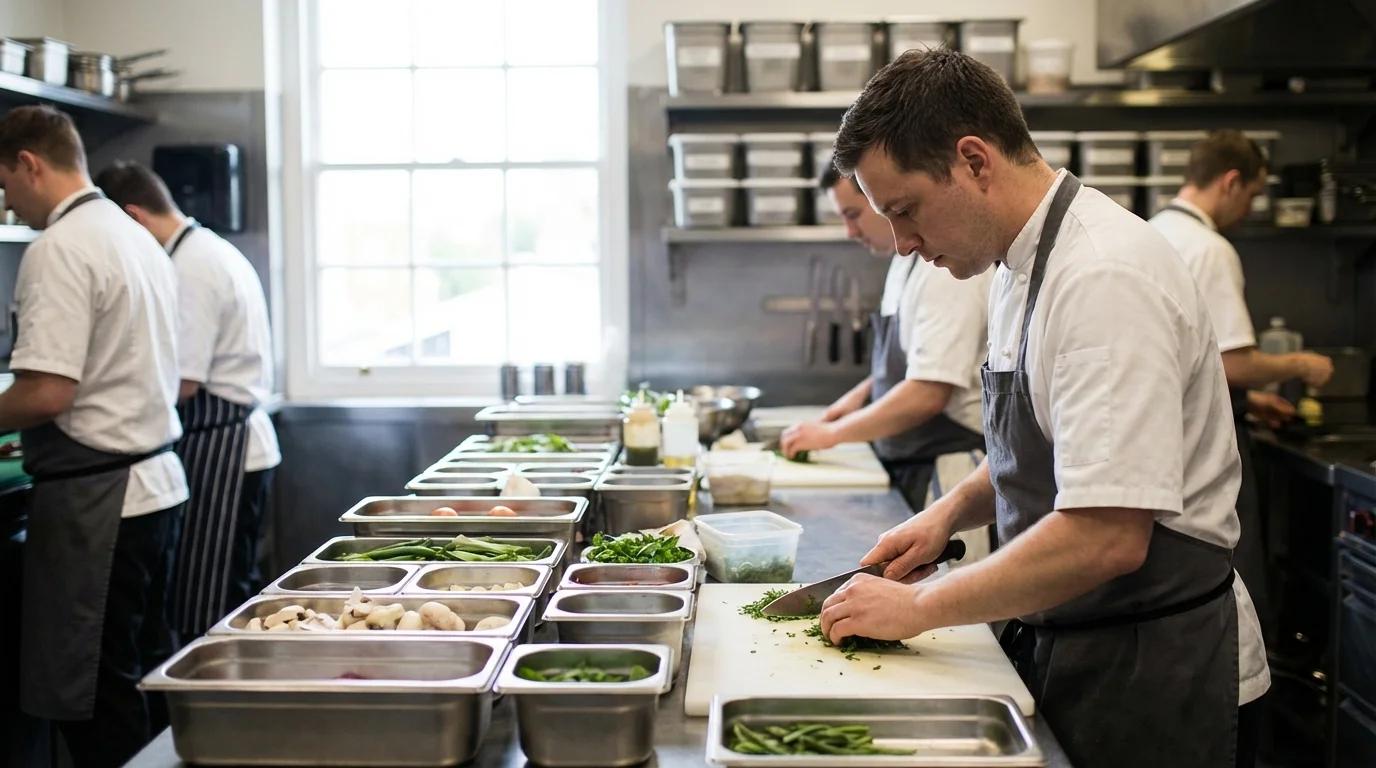
A head chef opens the walk-in cooler on Monday morning and finds three trays of marinated chicken from Sunday's service. They are perfectly edible, but they no longer fit the day's menu. They will go in the bin. It is not negligence. It is the logical result of a system that forces over-preparation because nobody knows with precision how much will be sold. Over-preparation is the rational response to uncertainty, but it is also the leading cause of food waste in organized food service.
The problem of preparing "just in case"
In any professional kitchen, running out of a dish during service is a visible and immediate failure. The waiter returns to the table, the customer is frustrated, the manager receives the complaint. It is what the industry calls "86-ing" a dish: pulling it from the menu because there is none left. To avoid it, kitchen teams do the most sensible thing they can with the information they have: prepare a safety margin.
In practice, that margin means producing 10% to 20% more than expected sales. In a single location it may seem manageable. In a chain of 20, 50 or 100 locations, each one applying its own criteria for "how much extra," the figures skyrocket. What starts as operational prudence becomes a structural cost and sustainability problem.
The hardest part to solve is that over-preparation generates no alarms. Unlike a stockout, which is noisy and immediate, excess production is silent. It dilutes among the day's waste, is recorded as "normal operating cost," and is rarely attributed to a specific cause. Nobody is responsible for having prepared too much because, in the absence of a reliable forecast, preparing too much was the right decision.
The scale of the problem: 12 million tonnes per year
The European Union's food service sector generates approximately 12 million tonnes of food waste every year. That figure includes plate waste, storage waste, and expired products, but a significant proportion corresponds to over-preparation: food that was cooked, was in perfect condition, and nobody ordered.
In economic terms, for a restaurant chain with 30 locations and an annual raw material cost of 3 million euros, 8% waste from over-preparation represents 240,000 euros per year literally thrown in the bin. It is not a marginal cost. It is an entire margin that vanishes without a trace in conventional operational reports.
Why measuring waste is not enough
In recent years, the HORECA industry has seen a wave of solutions focused on measuring food waste. Connected scales, cameras above waste bins, apps where staff record what is thrown away. These are useful and necessary tools, but they have a fundamental limitation: they tell you how much you wasted, but they do not prevent you from wasting.
Measuring is the first step, without question. Without data there is no improvement. But many chains that have been measuring their waste for months or years continue to waste similar quantities. They know they throw away 9% of production. They know roast chicken is the dish with the most waste on Tuesdays. They know the Seville location wastes more than the Bilbao one. And yet, the figures do not drop significantly.
The reason is simple: measurement diagnoses but does not treat the cause. If the head chef at the Seville location still does not know how many roast chicken servings will sell next Tuesday, they will continue to prepare "just in case." The waste data will confirm they prepared too much, but they already knew that. What they need is a reliable expected demand figure before starting to produce.
The root of the problem is uncertainty
Waste from over-preparation is not a discipline or training problem. It is an information problem. When a kitchen team has to decide how many servings to prepare for tomorrow's service, they have very few reliable references: the head chef's experience, what was sold last week, an intuition about whether the weather will be good or whether there is a nearby event.
That uncertainty generates a systematic bias toward overproduction. The cost of running short (lost sales, frustrated customers, complaints) is perceived as much greater than the cost of over-preparing (throwing away food nobody sees and recording it as generic waste). It is a rational but asymmetric calculation: the risk of running out of a dish is immediate and visible; the cost of over-preparation is diffuse and invisible.
How does Controliza turns prediction into production?
Controliza's Forecast module addresses the problem at its root: instead of measuring what has been wasted, it predicts what will be sold. The forecasting engine analyzes historical sales data by dish, day of the week, location, seasonality, weather, and events to generate a demand forecast at the individual item level.
But prediction alone does not change what happens in the kitchen. The critical step is converting that forecast into a concrete production order. That is where the Kitchen module comes in. From the demand forecast, Kitchen automatically generates the production plan for each site and each shift: how many servings of each dish to prepare, which ingredients to defrost, what the exact mise en place is.
The result is that the head chef no longer decides how much to prepare based on intuition. They receive a precise indication, backed by data, that eliminates the need to add arbitrary safety margins. It is not about distrusting their experience, but about complementing it with information no human can process manually: the intersection of thousands of historical and contextual variables for each dish at each location.
The specific case of the buffet
In buffet operations, over-preparation reaches its most extreme levels. The traditional logic is to load all trays at the start of service so the buffet "looks full." The result is predictable: at the end of breakfast or dinner, trays of food remain that cannot be reused.
Controliza's Buffet module uses computer vision to monitor consumption in real time. Instead of loading everything at the start, the system detects when a tray is running low and alerts the kitchen to replenish only what is needed. Replenishment shifts from preventive (filling just in case) to reactive and intelligent (replenishing what is actually being consumed).
The sustainability dividend
Reducing over-preparation has a triple impact that goes beyond direct savings on raw materials. First, it reduces operating costs immediately: less food prepared means fewer ingredients purchased, less energy consumed, and less waste to manage. Controliza's Purchasing module closes this loop by adjusting supplier orders based on forecast demand, also preventing overstock in the warehouse.
Second, it improves the group's ESG metrics. Food waste reduction is one of the most relevant indicators for investors, franchisors, and corporate clients who demand measurable sustainability commitments. Having real waste reduction data, comparable across periods and locations, transforms a generic commitment into a documentable competitive advantage.
Third, it anticipates regulatory compliance. The European Union has set binding food waste reduction targets for 2030. Spain's food loss and waste prevention law already requires HORECA businesses to have a prevention plan and a record of quantities wasted. Chains that already have a prediction and control solution in place will not need to improvise when regulatory pressure increases.
What impact does it have on margin?
HORECA groups that have implemented Controliza to manage demand forecasting and kitchen production report consistent results in the first months of use:
Data measured in active Controliza clients.
The waste reduction translates directly into purchasing savings: if you prepare less of what ends up left over, you buy less of what you do not need. In chains with more than 20 locations, the savings generated by reducing over-preparation typically exceed the full platform cost in the first quarter.
Is your chain still over-preparing due to lack of forecasting?
Discover how Controliza's Forecast module anticipates demand by dish, day, and location, and how Kitchen turns that forecast into exact production orders. Request a personalized demo and calculate the impact on your waste.
If you want to go deeper, we recommend reading Forecasting for Cyclic Menus: The AI That Understands Your Dish Rotation.

