It is 9:45 in the morning at a vacation hotel in the Canary Islands. The cook in charge of the breakfast buffet looks at the scrambled eggs tray: a quarter remains. There is an hour and a quarter until closing. Without thinking, he prepares a full 5 kg tray. At 11:00, when the team clears the buffet, 3.5 kg of scrambled eggs go straight to the bin. Every morning, the same scene repeats with bacon, pastries, fruits and cereals. The cook has no ill will. He simply has no data to decide how much to restock.
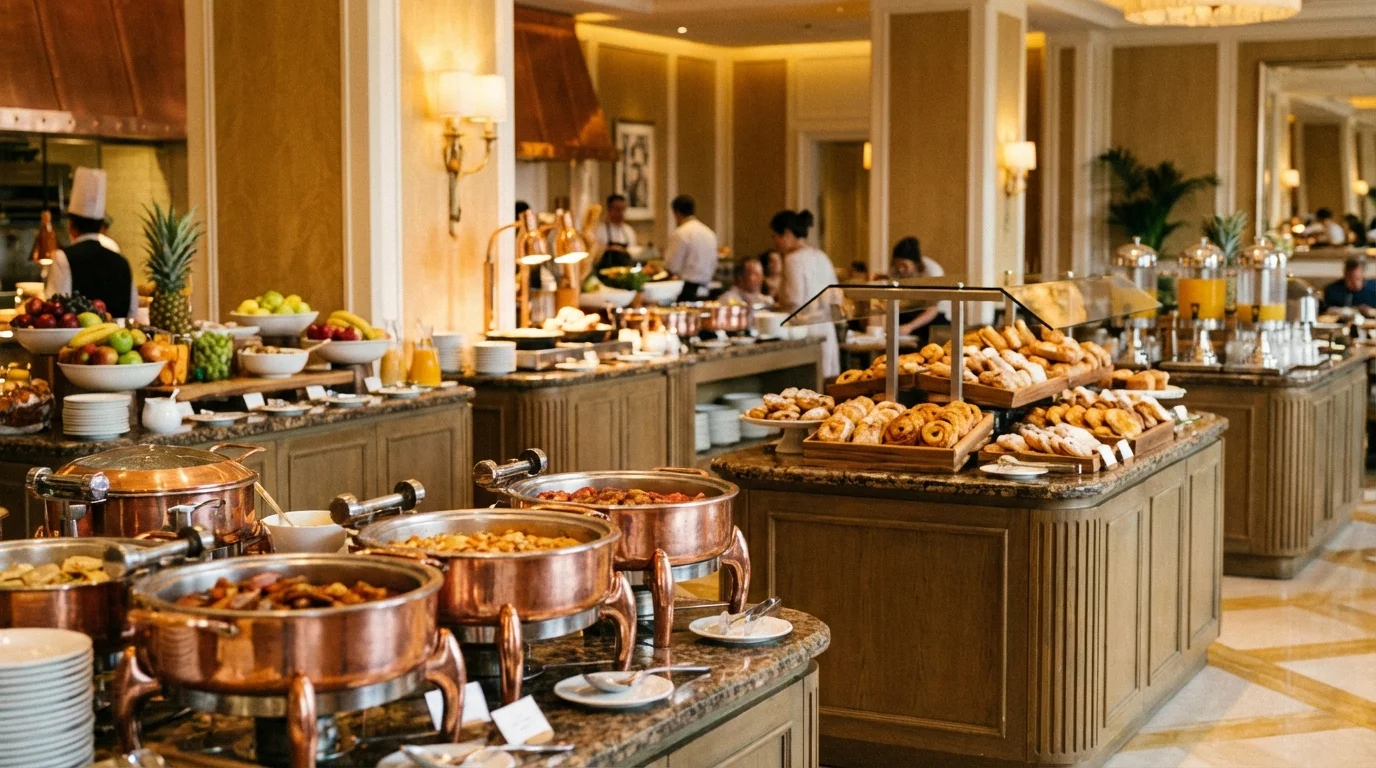
Restocking "by eye": the most expensive buffet mistake
Restocking is the critical moment of the buffet. It is when the decision is made about how much additional food to place on the service line to maintain presentation and prevent shortages. And it is, paradoxically, the moment where most of the waste is generated.
The problem is that restocking in most hotels is done by intuition. The cook visually assesses how much remains in the tray and decides whether to restock or not. If there is little left, they restock. But the key question is not whether there is little left, but how many diners are still to arrive, at what rate they are consuming and how much time remains until service closes. Without that data, restocking is always a shot in the dark.
The two symmetrical restocking errors
Restocking too early: the silent waste
When the cook sees a tray at 30%, their reflex is to fill it. It is understandable: nobody wants a guest to arrive at an empty tray. But if 45 minutes remain and 80% of diners have already passed, that full restock will generate a surplus that goes to the bin. At 7:30, restocking 5 kg makes sense. At 10:15, those 5 kg become 3.5 kg of waste.
A buffet without consumption data does not allow distinguishing between these two moments. For the cook, a tray at 30% is a tray at 30%, regardless of the time, occupancy or diner flow rate.
Restocking too late: the guest complaint
The other extreme is equally problematic. If the cook hesitates and waits too long, the tray empties. The guest arrives, sees the empty tray and perceives a poor experience. In a four or five-star hotel, those empty trays translate into negative reviews and direct complaints. The pressure to avoid this situation is what generates the bias toward overproduction.
Data measured in active Controliza clients.
The full tray trap
There is an implicit pressure in the buffet: the tray must be full. A half-empty tray is perceived as a poor experience, a sign that the hotel is cutting corners. This pressure is real and legitimate from the guest experience perspective. The mistake is not wanting to maintain presentation: it is confusing "adequate presentation" with "overflowing tray".
A tray with 1.5 kg of freshly restocked product offers a better experience than one with 4 kg of product that has been sitting for an hour and a half. But without a system telling the cook "restock only 1.5 kg", the natural reflex is to fill it.
Not differentiating between dishes
Not all buffet dishes are consumed at the same rate. Scrambled eggs and bacon disappear quickly between 8:00 and 9:30, but stagnate afterwards. Fruit has a more linear consumption. Cold cuts are barely touched after 9:00. Without differentiated consumption data by item, the cook restocks everything equally, with the same quantity and the same urgency.
The accumulated cost: the figure nobody calculates
A hotel with 300 rooms and a breakfast buffet can serve between 400 and 600 breakfasts daily. If waste from excessive restocking averages 15 kg daily at an average cost of 6 euros/kg, that is 90 euros per day. Multiplied by 365 days: 32,850 euros per year solely from poorly calibrated restocking.
In a chain with 10 hotels, that is more than 300,000 euros annually. And the most frustrating part is that this waste is completely avoidable. There is no need to reduce the quality of the buffet or the variety of the offering. You just need to know how much to restock and when.
How does Controliza solves it?
Controliza's Buffet module includes a smart restocking system that transforms the decision of "how much do I restock" from intuition to a precise data point.
Restocking alerts based on actual consumption
Weight sensors on each buffet tray monitor the level in real time. When an item drops below the configured threshold, the system generates an alert to the kitchen team indicating exactly how much to restock. Not a full tray, but the estimated amount based on the current consumption rate and remaining service time.
Dynamic adjustment by time and occupancy
The system cross-references tray levels with hotel occupancy data, service time and historical consumption for that day of the week. If 45 minutes remain and occupancy is low, the alert recommends restocking 1 kg instead of 5. If it is Saturday at 8:30 and the hotel is at 95%, it recommends a full tray restock because demand justifies it.
Historical restocking data by shift
Each restock is recorded: how much was added, at what time and how much was consumed afterwards. This history allows the executive chef to analyze patterns and adjust initial production quantities. If pastries are always left over after 9:30 on Tuesdays, initial production for that day can be reduced without affecting service.
Does your kitchen team restock the buffet with data or intuition?
Controliza turns every restock into a data-driven decision based on real-time consumption. Request a personalized demo and reduce your buffet waste from the first week.
From “fill another tray” to replenishment guided by real consumption
The problem isn’t just how much you replenish, but the criteria you use to decide it. In a buffet, each item follows a different consumption curve: fruit tends to have steady demand, pastries peak early on, and hot dishes drop sharply in the final service window. If you can’t see that pattern in real time, you end up applying the same logic to everything. The result: waste on some trays, service shortages on others, and a food cost that spirals out of control with no data to explain why.
With Controliza Buffet, replenishment no longer depends on your team’s intuition. Computer vision and automatic weighing measure real consumption by time slot, detect how much is left, and let you adjust staggered production to the demand still to come. Instead of preparing a full refill out of fear of running short, you can make an informed decision on whether you need half a tray, a third, or no further replenishment at all.
This operational shift has a direct impact: you reduce waste by 15% to 25%, lower cost per cover by 10% to 15%, and also generate an automatic waste record that supports traceability and regulatory compliance. It’s no longer about “guessing right” by eye, but about turning every replenishment into a profitable decision.
What changes when restocking follows real consumption
The solution is not to ask the team to “be more careful.” It is to give them operational intelligence at the exact moment they decide. With Forecasting and buffet monitoring, Controliza combines computer vision and automatic weighing to show what is being consumed in real time, how much remains, and how the curve is evolving by time slot.
That changes the logic of service. Instead of refilling a tray to full capacity, the kitchen can produce in smaller batches, adjust presentation without inflating waste, and protect the guest experience with data-backed restocking. The result is lower waste, tighter food cost, and more reliable recipe costing at buffet level.
It also closes the loop operationally. Surplus and discarded food are recorded automatically, which improves traceability, supports delivery notes and compliance records, and gives management a real picture of where waste is generated. In practice, hotels reduce buffet waste by 15–25% and cut cost per cover by 10–15%.
What impact does it have on margin?
Hotels implementing Controliza's smart restocking see immediate results:
If you want to go deeper, we recommend reading You're Wasting Food at the Buffet but Don't Know How Much: How to Measure to Improve.

