Continuing with the benefits that sales forecasting tools bring to the restaurant sector, today we will discuss the digital twin. This is a feature of the sales forecasting tool for restaurants that compares in real time what is happening with what should be happening.
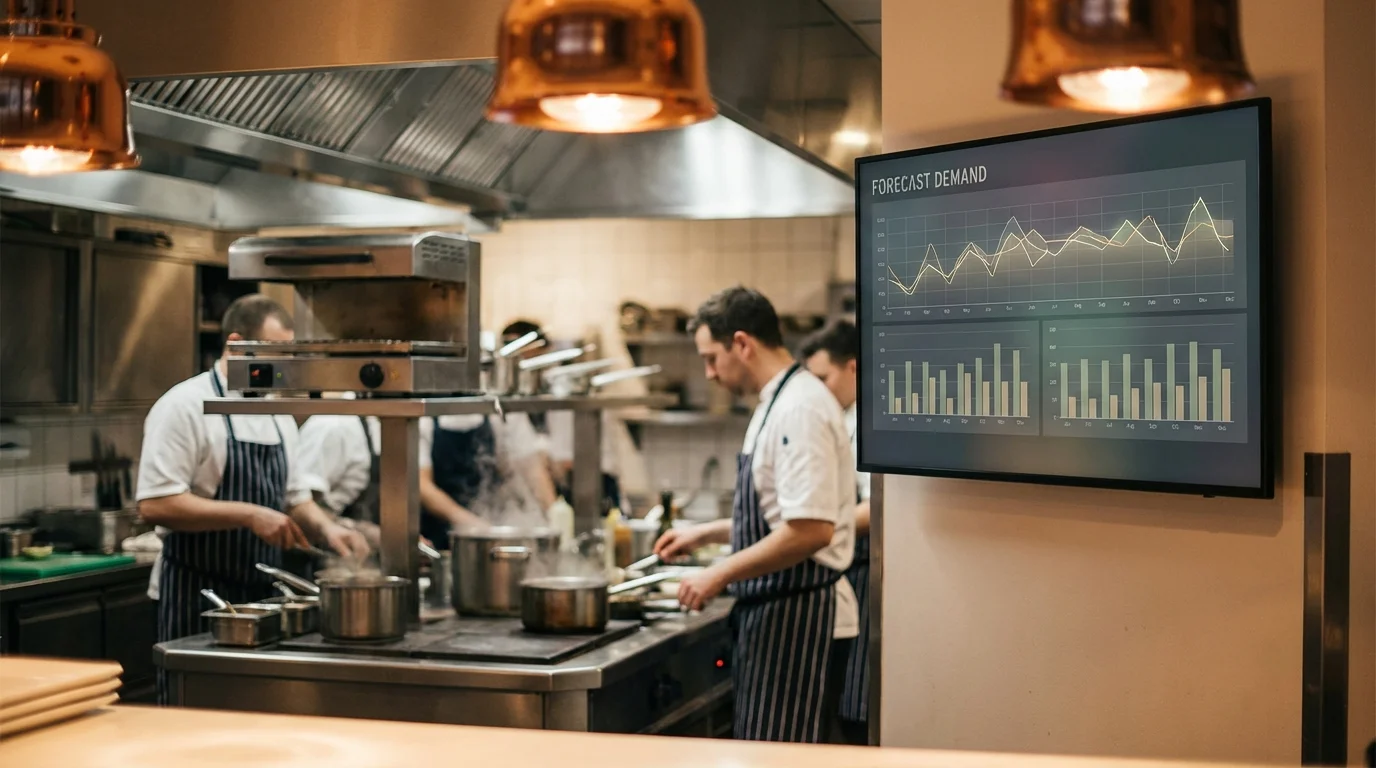
Sales forecasting applied to goal achievement and real-time decision-making in restaurants
From forecast to execution: how the digital twin turns predictions into operational decisions
The real challenge isn’t just predicting how much you’re going to sell, but turning that forecast into operational decisions that make an impact in the kitchen, purchasing, and front of house. In many HORECA businesses, information arrives too late or too aggregated: you know the day is “going well” or “going badly,” but you can’t spot in time whether the deviation is coming from a specific channel, a shift in demand for certain dishes, or an issue that is already affecting your production. That’s where the digital twin delivers real value. It doesn’t just compare projected revenue with actual revenue; it lets you translate the forecast into actionable variables: which dishes are selling faster, which items are underperforming, whether the mix between delivery, dine-in, and take away is changing, or whether an external event is disrupting the usual pace of service. With Prediction, Controliza takes this analysis to a much more useful level for day-to-day operations, because its AI doesn’t just anticipate demand by day and location, but also by dish, factoring in weather, holidays, events, and hotel occupancy so the forecast becomes truly operational rather than just a nice-looking number on a dashboard.
This has very specific day-to-day implications. If the digital twin detects that reality is drifting away from the forecast, it’s not just about “keeping an eye on” the venue, but acting before that deviation turns into waste, stockouts, or team overload. For example, if actual demand for certain dishes is running above forecast, you can bring forward defrosting, adjust mise en place, or review orders before you run out of product and the customer experience suffers. If the opposite happens and sales for a product family are below expectations, you can slow production, avoid unnecessary prep, and contain waste before it impacts food cost. This approach is especially important when you have large menus, strong seasonality, or high variability between locations, because the error usually isn’t in the day’s total, but in the detail. A restaurant may close close to projected revenue and still have produced incorrectly, overbought, or suffered stockouts on key products. That’s why the value of the digital twin isn’t just in monitoring, but in connecting prediction and execution so every operational decision is backed by real-time data.
On top of that, one of the biggest challenges in foodservice is that demand doesn’t behave linearly. It changes with the weather, holidays, local events, promotions, menu changes, or the channel mix. If you don’t have a tool capable of learning from those factors and distinguishing between a one-off anomaly and a real pattern shift, you end up managing by intuition what you should be managing with evidence. That is exactly what Controliza solves: its AI identifies the external factors that most affect each location, separates atypical behavior, understands how demand evolves when you change dishes or menus, and generates a much more precise forecast than one based only on historical data. This makes it possible to reduce waste by between 20% and 30%, cut stockouts by up to 40%, and keep the deviation between production and demand below 10%. In operational terms, that means less overproduction, fewer last-minute emergencies, fewer reactive purchases, and more control over recipe costing, procurement, and planning. And when that prediction is connected to the digital twin, you don’t just know what should be happening: you also know what is changing, why it is changing, and what you need to do to correct it.
In practice, this also improves coordination between areas that normally work with fragmented information. Purchasing can anticipate automatic orders with better judgment; the kitchen can prepare production aligned with expected demand; operations can compare locations with real context instead of isolated figures; and management can understand whether a deviation is due to an execution issue, a poor forecast, or an external factor beyond your control. It even impacts processes related to traceability and delivery notes, because better forecasting reduces urgent orders, improvised adjustments, and poorly planned stock movements between sites. Instead of reacting when the problem has already reached the till or the inventory, you work with a layer of operational intelligence that alerts you beforehand. That is the real leap forward: moving from looking at what happened to steering what is happening. And that is where the digital twin, powered by Controliza’s predictive capabilities, stops being an analytical function and becomes a day-to-day management tool that protects margin, improves execution, and helps you make timely decisions with less uncertainty and more control.
From forecast to purchasing and production without spreadsheets
When the forecast doesn’t make it down to operations, the problem snowballs: purchases arrive late, delivery notes don’t match real demand, recipe costing gets thrown off by changes in the sales mix, and teams end up producing based on intuition. In foodservice, it’s not enough to know how much you’ll sell; you need to turn that signal into specific quantities by item, shift, and channel to protect both margin and service.
With Prediction, Controliza turns the forecast into actionable decisions: what to prepare, what to defrost, what to order, and when to do it. By anticipating demand by dish, day, and location using variables such as weather, events, or hotel occupancy, you reduce overproduction before it becomes waste and avoid stockouts that ultimately impact the customer experience.
The impact is direct on food cost and operational traceability: less stock tied up, fewer last-minute adjustments, and production that is far better aligned with real demand. In practice, this can mean a 20–30% reduction in waste, up to 40% fewer stockouts, and production variances kept below 10%.
Why forecast accuracy fails without operational context
Forecasts often break down when they ignore channel mix, menu changes, outliers, or external factors like weather and events. That’s when overproduction, stockouts, and avoidable waste start pushing up food cost without being visible early enough.
With Forecasting, Controliza turns those variables into operational signals by dish, day, and location. You can adjust prep, purchasing, and production in time, cutting waste by 20–30%, reducing stockouts by 40%, and keeping production deviation below 10%.
What is the Digital Twin and how does it work?
Let us assume that the tool has already given us the latest forecast for a day. When that day becomes the present, that forecast is passed to the digital twin where we compare reality with the prediction.
This tool creates a "twin" for each of the locations where the forecast is placed (what should happen that day at that location). It then captures all real-time data from the POS or the business database and compares and displays them side by side with the forecast, so you can see whether what is happening is what should be happening or not. It also indicates if there has been any variation from the forecast (for example: weather) and whether it has caused a deviation in the prediction.
The idea is that this tool makes the sales forecast as accurate as possible, adjusting the prediction over time. The tool takes into account factors such as trends, historical data, weather or events that directly affect the KPIs relevant to the restaurant. These KPIs are typically revenue, diners, number of tickets, average ticket and products sold.
From here, we need to see whether reality aligns with the forecast within the confidence margins. If not, we must identify which variable caused the deviation. We can even detect if something is happening at the location itself that we were not aware of.
What benefits does sales forecasting applied to the digital twin in restaurants bring?
-Real-time monitoring: You can always stay informed, from any device, of the status of each company location.
-Mobile alerts: Set up mobile alerts for relevant business events.
-Make decisions on time: React when you see that targets are not being met.
In short, the "digital twin" is a tool that allows you to track forecasts for a specific location or the group in general, so you can see at all times how reality matches what should be happening. This tool also lets you set up alerts so that when certain events occur, it notifies you automatically without having to be glued to it 24 hours a day. And finally, it allows you to analyze deviations and be more effective -- in other words, know which locations perform better and why, which is decisive for seeking growth to scale the business.
If you want to learn more about our sales forecasting tool for restaurants, visit our website.
You can also visit our LinkedIn profile.

