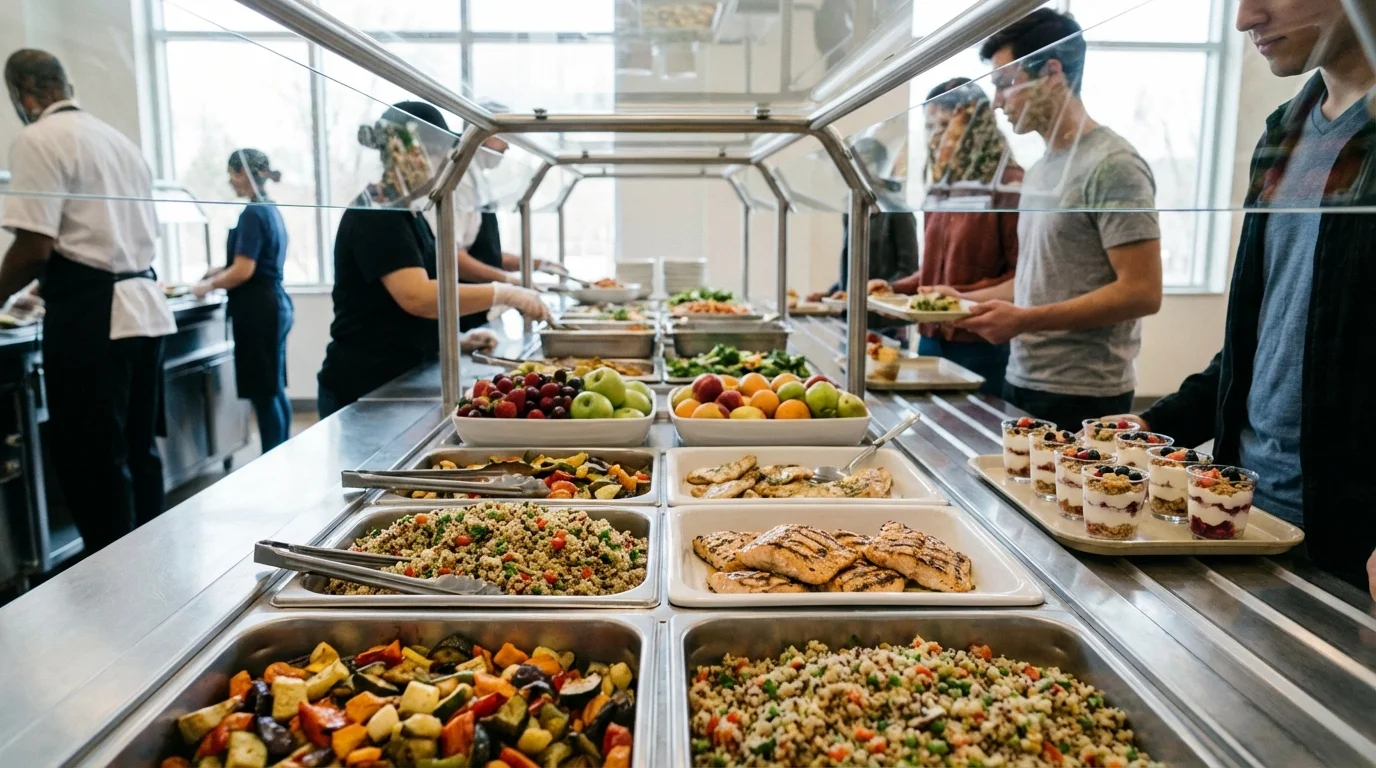
Tuesday, 12:45, canteen of an office tower with 2,000 employees. The kitchen has produced 1,400 servings, as always. But today is Tuesday and Tuesday is the office day for most teams in hybrid mode: 1,650 people show up. By 1:15 PM the main course runs out. Queues, complaints, improvisation with emergency pasta. Thursday, on the other hand, only 800 come down. 600 servings left over. Remote work has broken every attendance pattern you knew.
The new normal: unpredictable attendance
Before 2020, a corporate canteen had relatively stable demand. 85-90% of employees came down to eat every day. Variations were minor and predictable. The food service operator could produce for a fixed percentage of the headcount and get it right most days.
Hybrid remote work has destroyed that predictability. Each company in the building has its own policy: some require in-office Tuesday and Thursday, others Monday, Wednesday and Friday, others give total freedom. The result is a completely new weekly attendance curve, with peaks and valleys that vary by day, company, building floor, and even time of year.
Producing for 100% is no longer an option
The instinctive response of many operators is to produce for the maximum: if the building headcount is 2,000, produce for 2,000. That way nobody goes without food. But with average attendance of 60%, that means wasting 40% of production most days. In a canteen serving 2,000 people, we are talking about 800 daily servings of overproduction.
The cost of that waste is double: raw materials thrown away and production hours that generate no value. In a canteen with a raw material cost of 3 EUR/serving, 600 excess servings daily means 1,800 EUR daily loss. Monthly, over 36,000 EUR. Annually, close to 430,000 EUR.
Reservations vs walk-in: the false solution
Some canteens have implemented advance reservation systems to predict attendance. The idea is good in theory: if employees reserve in the morning, the kitchen knows how many to produce for. In practice, the reservation system creates its own problems. No-shows (reservations that do not show up) range between 15% and 25%. Walk-ins (people who did not reserve but come to eat) can represent another 10-20%. The net result is that reservations predict worse than a good statistical model.
Multi-tenant buildings: complexity squared
The situation becomes especially complex in multi-tenant buildings, where the canteen serves employees from 5, 10 or 15 different companies. Each company has its own remote work policy, in-person meeting days, quarterly conventions and vacation periods. The canteen operator has no access to each company's corporate calendars. They only see service data: how many people came down each day.
Data measured in active Controliza clients.
How does Controliza solves it?
Weekly pattern learning
The Forecast module of Controliza analyzes attendance history by day of the week and automatically detects patterns: Tuesday and Wednesday are peak days, Friday the lowest, Monday intermediate. But it goes beyond the basic pattern: it identifies that the first Tuesday of the month has 10% higher attendance (because many companies schedule monthly meetings that day), or that the week following a long weekend has a slower start.
Holiday and event integration
Controliza incorporates the calendar of holidays, long weekends and events as forecasting variables. A 4-day long weekend not only reduces attendance on non-working days: it also affects the Friday before and Monday after. The system learns these drag effects and adjusts the forecast automatically.
Remote work trend detection
If a company in the building changes its remote work policy (for example, going from 2 in-office days to 3), the overall canteen attendance pattern changes. Controliza detects these trend changes in weeks, not months, and adjusts the forecasting model to reflect the new reality. Nobody needs to inform the operator: the system detects it from service data.
From forecast attendance to actual production: where margin is won or lost
The issue isn’t just how many people are expected to come down for lunch, but how you turn that forecast into purchasing, recipe costing, and daily production without creating waste. In contract catering, an attendance error impacts the entire operation: over-ordering, delivery notes coming in for volume that won’t be consumed, cold rooms under pressure, preparations reaching expiry, and food cost spiraling even if service went “well.” And when you work with cyclical menus, not every day has the same level of sensitivity: some dishes are more popular, some sides rotate more slowly, and some main courses make surplus much more costly.
On top of that, there’s regulatory pressure. In corporate cafeterias, hospitals, schools, or care homes, it’s not enough to simply adjust portions: you also need to maintain traceability, comply with HACCP, and properly document what has been received, produced, and served. If the forecast is wrong, you don’t just lose margin; you also make receiving, delivery note control, and kitchen planning more difficult. The usual result is a reactive operation: last-minute calls to suppliers, improvised menu changes, and teams cooking with more uncertainty than necessary.
This is where a tool like Prediction from Controliza changes the approach. Instead of working with generic estimates, the platform combines historical consumption data, day-of-week behavior, menu cycle, and operational context to fine-tune expected attendance and translate it into real production needs. That makes it possible to optimize purchasing, reduce overproduction, and protect service without overloading the kitchen. In practice, it means less waste, fewer stockouts, and a direct improvement in food cost.
The key difference is that forecasting doesn’t live in an isolated spreadsheet. Controliza connects forecasting with purchasing, receiving, and traceability so decisions have a real operational impact. If you know more accurately what you’re going to serve, you can manage receiving better, validate delivery notes with confidence, and produce exactly what’s needed while maintaining food safety. In a low-margin environment, that coordination is what turns a kitchen that’s constantly firefighting into a profitable, controlled operation.
What actually improves forecast accuracy in hybrid canteens
The problem is not just knowing how many people may come down to eat. It is knowing what they will choose, at what time, and how that changes when external factors shift. A rainy Tuesday, a public holiday on Thursday, an internal company event, school vacations, or a heatwave can all distort demand in ways that historical averages cannot capture. That is why manual planning and static spreadsheets fail: they do not detect outliers fast enough, they do not work at dish level, and they do not translate attendance volatility into operational decisions.
This is where Forecasting changes the game. Controliza uses AI to predict demand by dish, day and site, incorporating variables such as weather, holidays, local events and occupancy patterns. Instead of producing a generic volume for lunch service, the kitchen gets a granular forecast that helps define mise en place, thawing, prep loads and purchasing needs with much more precision. The result is not only lower waste, but also fewer stockouts during peak service and tighter alignment between production and real consumption.
In practice, that has a direct impact on food cost. When you stop overproducing high-risk items and adjust prep based on expected demand, waste drops by 20-30% and service breaks can fall by 40%. Production deviation versus actual demand can be kept below 10%, which is critical in corporate canteens where margins are tight and employee satisfaction depends on consistency. Better forecasting also improves recipe costing, because planned output reflects realistic sales volumes instead of theoretical demand that never materializes.
For operators in multi-tenant buildings, this matters even more. You may not have access to every tenant’s calendar, but you can still build a reliable forecast from the signals your operation already generates: historical sales, delivery notes, menu rotation, seasonality and consumption behavior by weekday. The advantage is operational intelligence that turns uncertainty into planning discipline, with better traceability from forecast to production and less guesswork in every service.
Measurable impact in corporate canteens
Is your corporate canteen still producing for 100% of headcount?
Discover how Controliza learns real post-remote-work attendance patterns and lets you produce the right amount every day. Request a personalized demo and stop throwing away food.
If you want to go deeper, we recommend reading The group of 40 that broke your forecast: AI exception management and Social Dining Halls: Maximum Budget Efficiency.

