At Controliza, we fight food waste daily, a commitment that takes on special relevance on Food Waste Day. We are proud of our technological solutions, which constantly improve operational efficiency and promote sustainability within the HORECA sector. Our artificial intelligence platform is specifically designed to optimize the management of hospitality chains, achieving waste reductions of up to 30% and resulting in cleaner and more profitable operations.
Our advanced machine learning model processes both historical and current data, accurately predicting future demand. This predictive capability is key to adequately adjusting purchases and production, minimizing excess and reducing environmental impact. Implementing our technology not only decreases waste-related costs but also saves significant time by automating and simplifying complex processes.
In response to new legislation that demands more rigorous food waste management, our solution aligns perfectly with these requirements while enhancing operational efficiency. We actively participate in events, such as recently Autentica Food Fest in Seville, where we shared our knowledge about the great impact of Big Data in the restaurant industry, reflecting our commitment to education and technological advancement in the industry.
We encourage all companies in the sector to join us on this path toward more sustainable management. Discover how our solutions can transform your business at www.controliza.com. We are ready to help you improve your management and contribute to a more sustainable future.
From scattered data to action: how to reduce waste operationally across a HORECA chain
Food waste doesn’t only show up at the end of service, when you see unsold product or preparations you can no longer repurpose. It starts much earlier, in everyday decisions that seem minor but, multiplied across all your sites, end up directly affecting food cost, profitability, and operational consistency. Buying based on intuition, producing with inaccurate forecasts, receiving delivery notes without automatic validation, working with outdated recipe costing, or lacking real inventory visibility are some of the most common causes. In a HORECA chain, the problem is amplified because each site may be operating with different criteria, different suppliers, or replenishment habits that don’t reflect actual demand. The result is familiar: more waste, more stockouts, more overproduction, and less ability to correct issues in time. That’s why reducing waste isn’t just about “throwing less away,” but about building an operation where purchasing, kitchen, inventory, and traceability all work from the same data and shared rules.
That’s where an operational intelligence platform makes the difference. With Controliza, you don’t analyze waste as an isolated consequence, but as a symptom of imbalances you can detect and correct before they turn into cost. The connection between Prediction, Purchasing, Inventory, and Kitchen lets you anticipate demand more accurately, adjust orders, size production properly, and review deviations between what was planned and what was actually executed. If a product family shows recurring overpurchasing, if one site is generating more waste than the others despite similar sales, or if a recipe costing sheet doesn’t reflect actual raw material consumption, the platform flags it so you can act with clear criteria. This completely changes the way you manage operations: instead of reviewing incidents after you’ve already lost margin, you intervene in the operational causes generating that waste. In practice, this means less surplus, less unnecessary purchasing, fewer hours spent consolidating information manually, and a waste reduction of over 20%, along with food cost improvements of between 3% and 5% when data is used across the entire chain.
The key is making waste reduction actionable day to day, not just visible in a report. For example, when you centralize delivery notes, inventories, and consumption data, you can detect differences between what was purchased, what was received, and what was actually used. That helps you identify receiving errors, supplier issues, deviations in portion sizes, or unrecorded losses. And if you work with live recipe costing instead of theoretical spec sheets that no one reviews, you can recalculate real costs and understand which dishes or processes are eroding margin due to over-portioning, poor planning, or low turnover. In buffet operations, this visibility is even more important: producing extra so you don’t run short may seem like a safety measure, but without a detailed reading of consumption patterns, occupancy, and behavior by time slot, it becomes a constant source of waste. With operational intelligence, you can adjust replenishment, quantities, and production windows without compromising the customer experience. And when that logic is replicated across all sites, with consistent benchmarking and full traceability, learning no longer depends on each individual team and becomes a competitive advantage for the group.
There’s also a strategic implication that many chains still underestimate: sustainability is only credible when it is supported by measurable processes. Reducing waste is not just a matter of reputation or regulatory compliance; it is a direct way to protect margin in an environment of volatile costs and to raise the level of operational control. If you know what you buy, what you receive, what you transform, what you sell, and what is lost at each stage of the process, you can make much faster and more accurate decisions. Controliza lets you do this from a single platform, with traceability, alerts, and comparative analysis between sites so the data doesn’t stay at management level, but reaches purchasing, operations, kitchen, and management control. This shared visibility speeds up the correction of deviations, improves coordination between teams, and shortens the time it takes for an improvement to become a financial result. That’s why talking about artificial intelligence applied to waste is not about an abstract layer of technology, but about a more mature way of operating: less intuition, more control; less reaction, more anticipation; less waste, more sustainable profitability.
How does to reduce buffet waste with real consumption data?
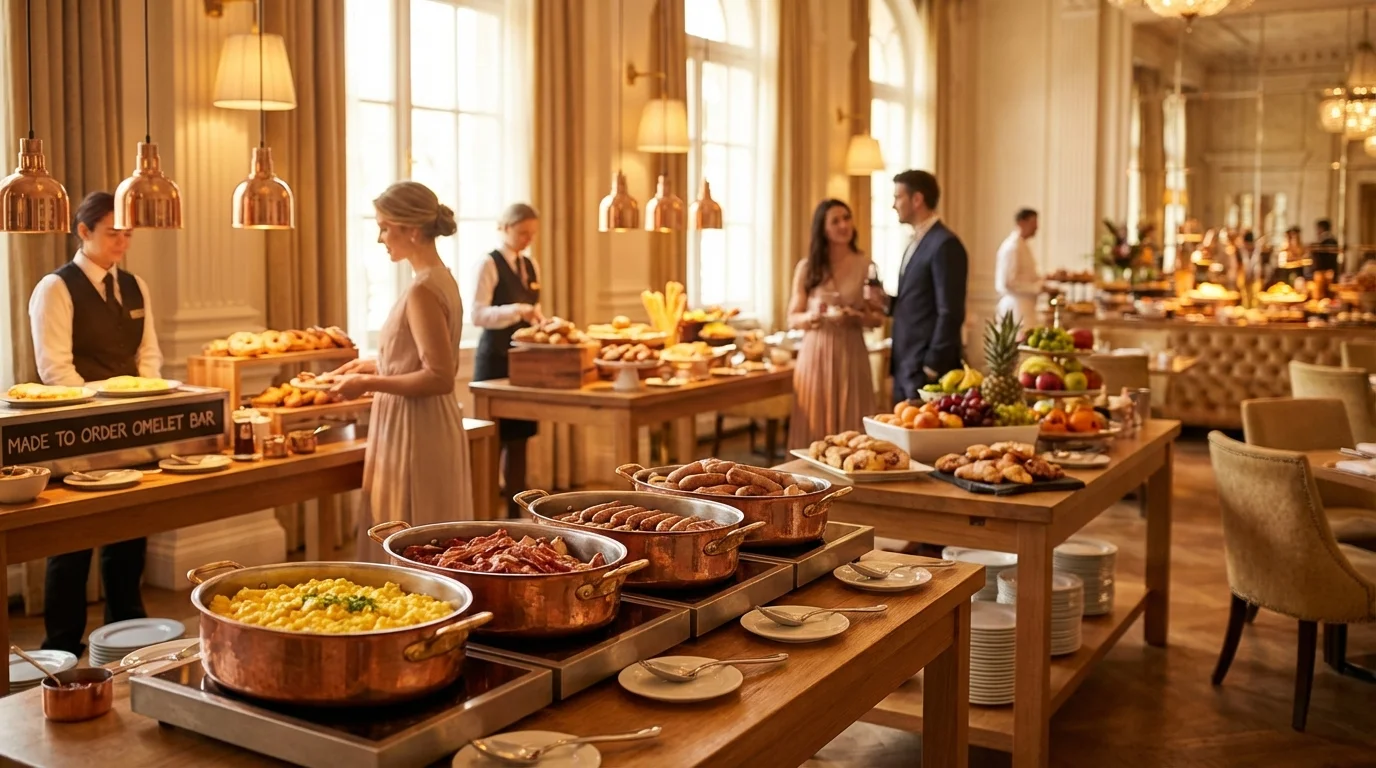
Buffet operations concentrate some of the most difficult waste problems in HORECA. You need abundance on display to protect the guest experience, but that same requirement often leads to overproduction, late-service leftovers, and replenishment decisions made by intuition instead of data. When teams refill trays “just in case,” without visibility into actual consumption by time slot, waste grows silently while food cost drifts upward. The issue is even harder to control across a chain, where each site may follow different replenishment habits, record waste inconsistently, and interpret compliance obligations in its own way. In that context, the buffet becomes a blind spot: you know there is waste, but not exactly when it happens, which products drive it, or how to adjust production without affecting service levels.
Controliza solves that blind spot by turning buffet service into a measurable operation. With Controliza Buffet, computer vision and automatic weighing capture real consumption and waste in real time, so you can stop relying on estimates or end-of-shift assumptions. Instead of producing a full volume upfront and hoping demand matches, your teams can work with consumption curves by hour, service period, and product category. That makes staggered production possible: preparing and replenishing based on actual demand patterns rather than habit. The operational impact is immediate. You reduce unnecessary refills, detect which items lose rotation after certain times, and identify where presentation standards are generating excess. Combined with Forecasting, this gives you a much more precise basis for purchasing and prep planning, connecting buffet behavior to broader decisions around waste, inventory, and food cost.
This level of visibility also changes how you manage compliance. Many businesses still approach food waste regulation as a documentary exercise: staff note down discarded quantities manually, often at the end of service, with limited detail and uneven discipline. That creates weak traceability and poor-quality data for corrective action. Controliza automates waste registration directly from the operation, which helps you document what was discarded, when it happened, and where the deviation started. Instead of treating compliance as a separate administrative task, you integrate it into the daily workflow. That matters not only for legal readiness, but for continuous improvement: once waste is quantified reliably, you can compare sites, refine production rules, and update recipe costing based on what is actually consumed versus what is prepared and discarded.
The result is not just a cleaner buffet, but a more profitable and controllable service model. Clients using this approach achieve waste reductions of 15% to 25% and lower cost per cover by 10% to 15%, while improving operational consistency. More importantly, they move from reactive correction to proactive control. Managers can see whether waste comes from poor timing, oversized batches, low-rotation items, or purchasing decisions that don’t match real demand. Central teams gain a shared operational language across sites, with comparable data instead of subjective explanations. And because buffet consumption is connected to delivery notes, traceability, and recipe costing, the improvement doesn’t stay isolated in one service area: it strengthens the entire chain’s ability to protect margin, reduce waste, and make better decisions every day.
If you want to go deeper, we recommend reading How to Waste Less Food in Restaurants.

