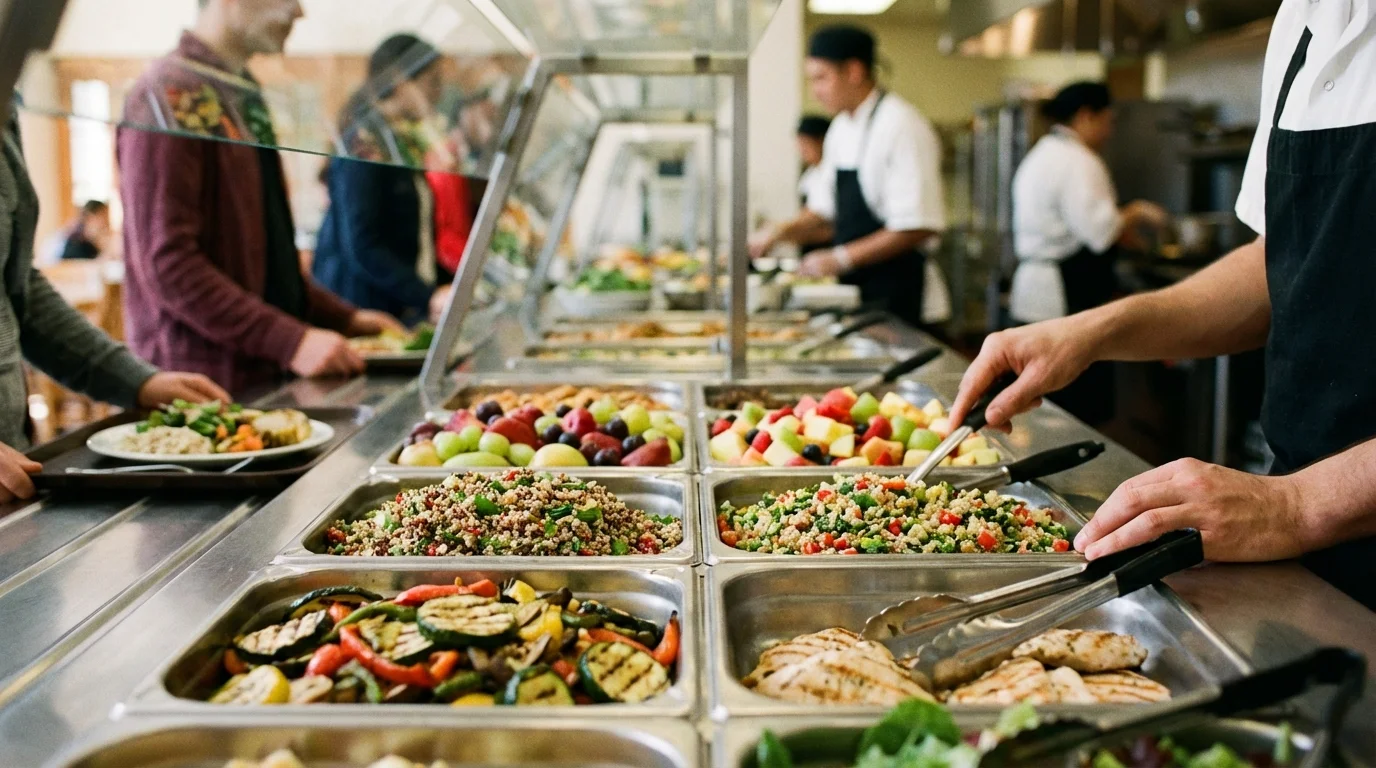
Wednesday, 11:30 AM, kitchen of a social dining hall serving 350 meals a day. The coordinator checks the walk-in cooler: yesterday, 200 kg of vegetables arrived as a donation from a supermarket, with a best-before date just 2 days away. There are also 50 kg of chicken from the regular supplier and leftover legumes from Monday. The monthly budget is already 80% committed with 10 days left until month-end. She has to decide what to cook with what she has, for how many people, and how to stretch every ingredient to the maximum. In a social dining hall, every euro misspent is a meal someone doesn't eat.
The challenge: minimum budget, maximum need
A social dining hall doesn't operate like a restaurant or a corporate cafeteria. There is no margin for inefficiency. There is no sale price to absorb the cost of what gets thrown away. Every euro of public funding or donations must translate into the maximum number of nutritious meals possible. And when that budget is 1.50-2.50 per meal, the margin for error is practically zero.
Demand forecasting in a social dining hall doesn't seek to maximize margin. It seeks something far more fundamental: minimizing waste so that every resource becomes food served. And that forecasting is much harder than in any other type of food service, because demand depends on social variables that no traditional model can capture.
Unpredictable demand: social variables, not commercial ones
In a restaurant, demand depends on the day of the week, the weather and local events. In a social dining hall, demand depends on entirely different factors: outdoor temperature (attendance rises in winter because people seek a warm place), the neighborhood's economic situation, the benefit payment calendar (demand drops on payment days), outreach campaigns from other social organizations, and factors as unpredictable as a migration wave or a sectoral economic crisis.
These factors don't follow clean weekly patterns. A Monday in January with a cold snap can have 40% more attendance than a Monday in January with mild temperatures. The benefit payment week reduces attendance by 15-20%. The end of the month, when many families have exhausted their resources, generates peak demand. Predicting this demand with the kitchen manager's intuition works sometimes, but generates systematic waste that could be avoided.
Donations: the inventory you don't control
A unique feature of social dining halls is that part of the inventory isn't purchased: it's received. Donations from supermarkets, restaurants, food banks and individuals are fundamental to operations, but they introduce additional uncertainty. You don't know what you'll receive, when, or in what quantity. And most donations have a short shelf life.
Data measured in active Controliza clients.
Managing this mixed flow (planned purchases + unplanned donations) requires planning capabilities that go far beyond a spreadsheet. When a 200 kg vegetable donation arrives expiring in 48 hours, you need to immediately know how to incorporate it into the next two days' menu, how many additional meals you can prepare with it, and how to adjust planned purchases to avoid duplication.
Maximum utilization: cooking with what you have
In a social dining hall, overproduction isn't just a cost problem: it's an ethical problem. Every kilo of food thrown away could have fed someone. That's why the goal isn't just to predict how many people will come, but to optimize production to extract the maximum number of meals from available ingredients.
This implies a production logic inverse to that of a restaurant. In a restaurant, you decide the menu and buy the ingredients. In a social dining hall, you often look at what you have and decide what you can cook with it. Menu planning must be flexible and adaptive, capable of incorporating unexpected donations without compromising nutritional balance or food safety.
How does Controliza solves it?
Controliza adapts its forecasting and purchasing capabilities to the specific context of social dining halls, where the goal isn't margin but maximum utilization of every resource.
Forecasting adapted to social variables
Controliza's Forecast module learns the specific patterns of a social dining hall: the effect of temperature, benefit payment cycles, social seasonality (end of month, holidays, start of school year). The model trains on the actual attendance data of the dining hall itself and continuously improves as it accumulates historical data.
Integrated donation management
When a donation is registered in the system, Controliza automatically integrates it into the planning. The Purchasing module adjusts planned orders to avoid duplication, prioritizes the use of products with the shortest shelf life, and suggests recipes that maximize the utilization of donated ingredients. All with full visibility of cost per meal and available inventory.
Maximizing meals per budget
Controliza allows dining hall coordinators to see in real time how many meals they can produce with current inventory and the remaining monthly budget. If the forecasting model indicates that 20% more people will come next week due to a cold snap, the system suggests adjusting purchases and menus to cover that demand without exceeding the budget, prioritizing affordable, high-yield ingredients.
Social impact visibility
For the organizations managing social dining halls, accountability to public and private funders is fundamental. Controliza automatically generates impact reports: meals served, cost per meal, utilization percentage, inventory origin (purchased vs. donated) and demand trends. Data that previously required weeks of manual compilation.
From delivery note to portion: decide earlier to waste less
In a social dining facility, the challenge is not just knowing how many people will show up. It is also about turning a constantly changing inventory into useful operational decisions. If today you receive donations with a short shelf life and tomorrow part of the expected order does not arrive, the team needs to set priorities fast: which product should be used first, which recipe allows for the best use of ingredients, how much should be prepared, and which purchase can wait. When this is managed through phone calls, loose sheets of paper, or memory, invisible waste, duplicate purchases, and traceability errors appear, ultimately driving up the real food cost of each portion.
This is where a platform like Controliza brings a practical advantage. With Forecasting, service history, seasonality, and site incidents are turned into a more reliable forecast to fine-tune production. And by connecting purchasing, delivery notes, receiving, and inventory, the person in charge can see which raw materials need to be used first, which menus can be adapted without compromising nutritional value, and where money is being lost through overproduction or expiry. The result is not just “cooking better”: it is serving more useful portions with the same budget.
In addition, in environments where documentation requirements are high, integrating HACCP and traceability into day-to-day operations prevents control from depending on paper records. Recording incoming goods, temperatures, batches, and usage by preparation makes it possible to justify donations, respond to inspections, and reduce the team’s administrative workload. Less time chasing data and more ability to make decisions on time: that is the difference between reacting when waste has already happened and anticipating it to prevent it.
Measurable impact in social dining halls
Organizations managing social dining halls with Controliza report significant improvements in efficiency and utilization:
Do you manage social dining halls and want to maximize every euro?
Discover how Controliza can help you forecast demand, manage donations and serve more meals with the same budget. Request a personalized demo and see the impact on your operations.
If you want to go deeper, we recommend reading Digitalization in Hospitality: Keys to Digitizing Your Business and Care homes: adapted menus and cost per resident as a key metric.

