The application of artificial intelligence in the hospitality sector is transforming the way restaurants and bars manage their operations, from demand forecasting to resource optimization. This approach enables anticipating customer needs, reducing waste and maximizing profits, all thanks to real-time data analysis and advanced algorithms.
What is the application of AI in hospitality?
The application of artificial intelligence consists of using machine learning algorithms and neural networks to process large volumes of business data (sales, stock, reservations, consumption patterns) and offer recommendations or automated actions. In hospitality, it is used to:
- Forecast daily or weekly demand based on seasonal trends and local events.
- Automatically adjust supplier orders based on sales forecasts.
- Personalize promotions and menus based on regular customer behavior.
Thanks to this technology, establishments can make informed decisions instantly and adapt their operations proactively.
Benefits of AI application in restaurants and bars
- Inventory and purchasing optimization
Avoid excess stock and reduce waste by adjusting orders in real time. Less waste translates directly into cost savings. - Improved customer experience
With personalized recommendations (most demanded dishes by diner profile), customer loyalty increases along with average ticket value. - Reduced operational time
Automating repetitive tasks, such as delivery note generation or invoice reconciliation, frees the team to focus on service. - Increased profitability
Efficient resource management and a supply better aligned with demand raise profit margins.
The result is an agile business, capable of reacting to last-minute changes and with greater competitive capacity.
Success stories: Restaurants using AI to improve their management
- Urban gourmet chain: applied predictive systems to adjust working hours per employee. Achieved a 25% reduction in labor costs during low-traffic weeks.
- Eco bistro: implemented a seasonal ingredient analysis module. Reduced food waste by 30% and adjusted menu prices based on actual production cost.
- High-volume restaurant: used intelligent chatbots to manage reservations and frequent inquiries, freeing 40% of the phone support team.
These examples demonstrate that the application of artificial intelligence is not a luxury, but an investment with measurable returns in a few weeks.
How does Controliza implement AI?
Controliza integrates AI across several key modules:
- Demand prediction: analyzes historical data and external factors (events, weather, holidays) to generate daily forecasts.
- Automated purchasing management: converts those forecasts into purchase orders to suppliers, avoiding overstock and stockouts.
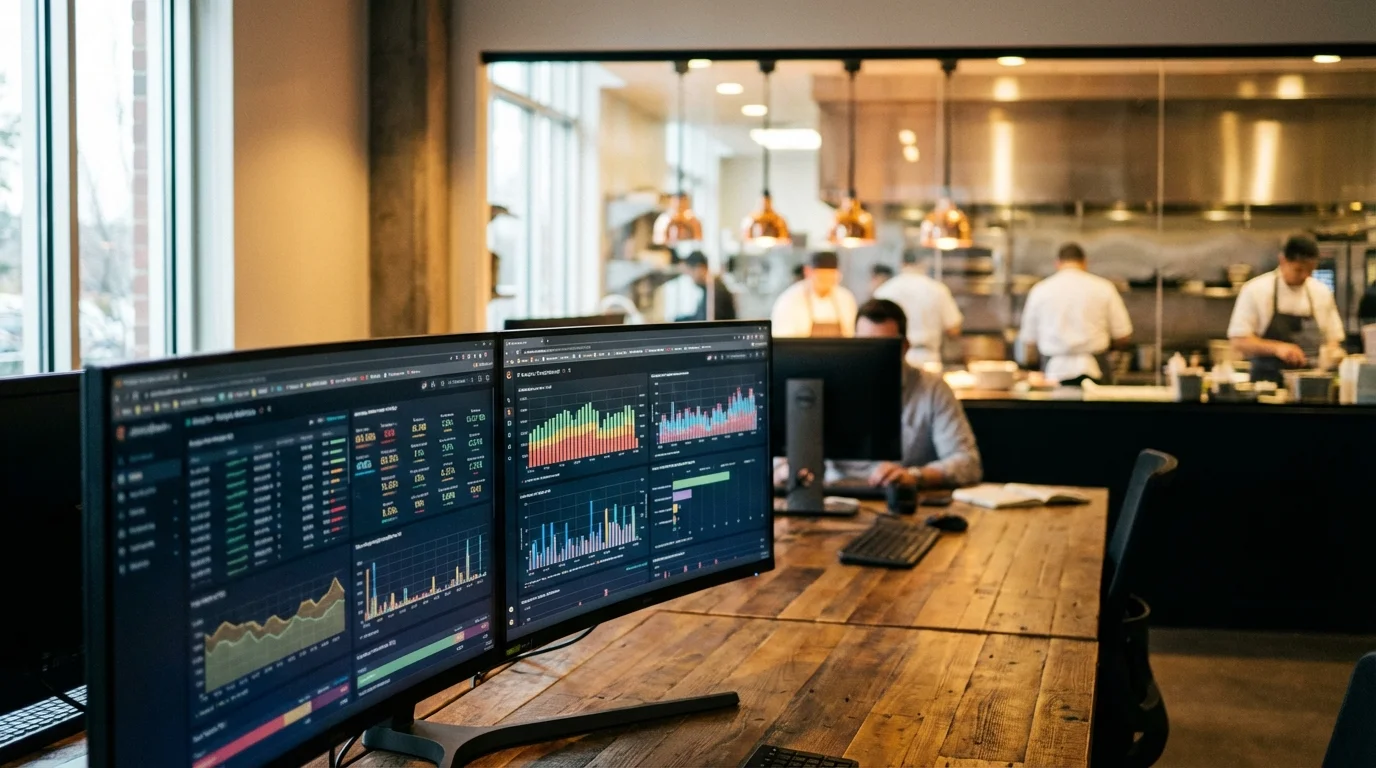
- Custom Business Intelligence: dashboards displaying real-time KPIs (hourly sales, gross margin, raw material costs) and proactive alerts.
Additionally, Controliza allows configuring tolerance parameters (safety percentage on minimum stock) and receiving instant notifications via email or mobile app.
Future trends in AI application in hospitality
- Computer vision
Smart cameras that analyze customer flow and count dishes served to adjust kitchen preparation in real time. - Sentiment analysis
AI that processes social media opinions and online reviews to gauge customer satisfaction and detect areas for improvement. - Robotic automation
Kitchen and service robots guided by internal route optimization algorithms, reducing wait times. - IoT integration
Sensors in refrigerators and pantries that record temperature and stock levels, reporting directly to the AI system.
These innovations will expand AI application capabilities, making processes even more precise and autonomous.
From isolated forecasting to operational execution: where AI delivers real profitability
The problem usually isn’t a lack of data, but that each area of the business works with a different version of reality. Purchasing looks at historical consumption, the kitchen adjusts on the fly, operations fixes issues only after they have already affected service, and management sees the outcome when margins have already deteriorated. In that context, applying AI only to demand forecasting falls short. If the forecast isn’t connected to ordering, inventory, recipe costing, production, and traceability, the improvement gets lost in day-to-day operations. That’s why profitability doesn’t depend only on “predicting better,” but on turning that prediction into executable decisions across all locations, with consistent criteria and in real time. That’s where a platform like Controliza makes the difference: it doesn’t add another layer of information, it turns shared data into an operational sequence that reduces deviations before they become extra cost.
In practice, this means AI stops being a theoretical tool and becomes a food cost control system. If you detect an upward forecast in certain shifts or categories, that signal should automatically translate into purchasing recommendations, tighter stock levels, and production planning aligned with actual turnover. If supplier costs also change or discrepancies appear between delivery notes, orders, and goods received, the system should reflect that impact on recipe costing and alert you to margin deviations without waiting for month-end closing. With Forecasting, Purchasing and Inventory, Controliza connects these decisions so they don’t depend on spreadsheets, calls between locations, or manual reviews. The result is a sustained food cost reduction of 3% to 5% and a waste reduction of more than 20%, because AI doesn’t just analyze: it acts on the points where profitability is really lost.
Another critical issue in hospitality is that many margin leaks don’t come from major mistakes, but from small repeated deviations: a delivery received with unrecorded discrepancies, a recipe executed outside standard, an urgent off-catalog purchase, an oversized buffet, or waste that hasn’t been properly allocated. When these incidents multiply across several locations, the cumulative impact is far greater than it appears in day-to-day operations. The advantage of unified operational intelligence is that it allows you to detect patterns and correct them quickly. If a product shows systematic overconsumption, if a family of dishes loses margin due to cost variation, or if a category concentrates traceability incidents, the platform identifies it and routes it to the right team to take action. Controliza also integrates the kitchen and traceability layer so execution stays aligned with the financial data: what you buy, what you receive, what you produce, and what you sell are all connected. This allows you to move from reactive management to preventive management, with less operational friction and greater control over your P&L.
For a HORECA chain, this approach also has a strategic implication: scaling without losing control. The more locations you have, the harder it becomes to maintain consistent purchasing, production, and cost-monitoring criteria. Without a common foundation, each unit ends up resolving issues in its own way, which increases margin variability, complicates traceability, and limits continuous improvement. Controliza addresses this challenge with an integrated operational intelligence platform that unifies processes and gives management, operations, purchasing, and kitchen teams visibility over the same data. It’s not just about automating tasks, but about standardizing decisions and prioritizing actions with real financial impact. That’s why the return doesn’t depend on a single module, but on the combined effect of forecasting, purchasing, inventory, kitchen, buffet, and traceability. When your entire operation speaks the same language, you can react sooner, buy better, produce more accurately, and reduce the invisible losses that erode margin every week. That’s the point where AI stops being a promise and becomes a measurable competitive advantage, with positive ROI within 3 to 6 months.
AI in collective catering: tighter control over food cost, waste and compliance
In collective catering, profitability is harder to protect because margins are tight, volumes are high and planning errors scale fast. Company canteens, schools, hospitals and care homes work with fixed or cyclical menus, so a small mismatch between expected diners and actual consumption quickly turns into waste, stock shortages or unnecessary emergency purchases. On top of that, teams must keep delivery notes, traceability records and food safety controls aligned with purchasing and reception, which increases operational pressure.
This is where AI delivers practical value beyond generic forecasting. With Forecasting, Controliza adapts demand prediction to menu cycles, service calendars and historical consumption patterns, so purchasing is based on what will actually be produced and served. That improves recipe costing accuracy, protects food cost and helps reduce avoidable waste before it happens, instead of correcting it at month end.
Controliza also connects purchasing, goods reception and APPCC traceability in one workflow. When delivery notes, supplier data and incoming quantities are matched in real time, you gain tighter control over deviations, stronger compliance and faster audits. The result is a more predictable operation, lower waste, better traceability and decisions based on real margins, not assumptions.
Why choose a solution like Controliza?
- Easy implementation: connection with common POS systems (Loomis PAY, Revo, Last.app) and synchronization in just hours.
- Ongoing training and support: specialized team accompanies you at every step and adapts the system to each location's specific needs.
- Scalability: ideal for both independent bars and multi-location chains.
- Guaranteed ROI: Controliza's internal studies show an average 20% increase in profitability and a 30% reduction in waste after three months of use.
Investing in artificial intelligence with Controliza means staying ahead of the market, saving costs and offering a more efficient and personalized service.
Conclusion
Adopting artificial intelligence in hospitality is key to improving operational efficiency and profitability. Companies like Controliza offer complete solutions integrating demand forecasting, purchasing management and business intelligence, providing a fast and tangible return on investment. For any establishment seeking to compete in a demanding market, AI has become the indispensable tool.
